Arvin’s return to the Russell homestead and prayer clearing
The Devil All the TimeArvin’s return to the Russell homestead and prayer clearing turns a journey home into a reckoning with grief, memory, and his father’s faith. The house and the clearing have fallen into ruin, but their remaining objects—an old feed bucket, the prayer log, and Jack’s bones—give Arvin a way to revisit what he had misunderstood. His attempt to pray there again becomes both an act of mourning and the prelude to a confrontation with Sheriff Lee Bodecker.
The journey back
The return begins after Arvin reads that the sheriff’s sister and her husband have been murdered. The newspaper reports that the couple had been returning from Virginia Beach and names no suspect, but it includes a photograph of Lee Bodecker. Arvin recognizes him as the officer on duty the night Willard killed himself. Alarmed, Arvin packs his belongings, then goes back for the Calvary picture on his motel-room wall. He wraps it in the newspaper carrying the murder report and puts it in his bag: the image that will later be placed at his father’s clearing travels with news of the killings and the sheriff’s connection to his past.
Arvin heads west on foot. A logging truck takes him toward Bainbridge and leaves him at Route 50 and Blaine Highway; he crosses Paint Creek at Schott’s Bridge and reaches Knockemstiff about an hour later. Eight years have passed since he left. The landscape is recognizable, though a couple of ranch-style houses now occupy part of what had been a cornfield. At Maude's store, he finds Hank still working behind the candy case, older and more frazzled. Arvin sets down his gym bag, takes a bottle of root beer, and drinks before continuing toward the old property. This brief stop places his return in the ordinary life of the holler, even as the newspaper and his hurried departure have already set the journey in motion.
The homestead in ruins
Arvin follows the deer path he once walked with Willard toward the prayer log. The house is gone. He enters where the back door used to be, passes through the kitchen and hall, and reaches the room where Charlotte died. He searches the cinders and charred lumber for a keepsake from her or for one of the small possessions he had kept by his bedroom window. Nothing remains except a rusty doorknob and his memories. A neat row of empty beer bottles on the rock foundation marks someone else’s recent presence, but offers no explanation for the absence around it.
The barn has also deteriorated: its siding is gone, and its roof is rusted through. In a corner Arvin finds the feed bucket Willard once used to carry blood. He moves it to the front of the barn and sits on it while eating lunch. The object connects the derelict building to the sacrifices Arvin remembers, but now it is simply a seat in a damaged structure. During this pause he takes out a photograph of a woman with a dead man and considers why anyone would do such a thing. He also wonders how the woman’s bullet missed him at such close range. The photograph remains unexplained in this encounter, but its presence links the violence he has witnessed to the questions he carries back to the old property.
Revising his memory of Willard
The clearing Willard made is partly overgrown, yet the prayer log and five of the crosses remain upright; four others lie on the ground among trumpet vines. At the first cross, Arvin sees what remains of Jack. The sight brings back the period before Charlotte’s death and Willard’s desperate efforts to keep her alive. Arvin recognizes that his father had been willing to endure the blood, insects, heat, and other hardship involved in his sacrifices for her. Standing in the place that had been Willard’s church, he reaches a new understanding: Willard had believed he needed to go where Charlotte went so he could continue looking after her.
That realization alters Arvin’s long-held judgment of his father. He had despised Willard for leaving him after Charlotte died, as though the boy’s fate had meant nothing to him. Now he recalls the ride back from the cemetery, when Willard spoke of visiting Emma in Coal Creek and suggested that Arvin stay there. Arvin understands the suggestion as the closest his father could come to saying that he, too, was leaving and was sorry. The memory does not undo the abandonment Arvin experienced, but it supplies an intention and an apology he had not previously recognized.
Arvin gathers Jack’s remains, including the skull, collar, and bones, and buries them at the foot of the dog’s cross. The small bullet hole in the skull recalls how Jack died, while the burial gives Arvin a concrete act of care to perform in a place shaped by Willard’s rituals. He hangs the Calvary picture from the motel on a nail in the cross. The picture that he carried away from his room now becomes part of the clearing’s arrangement, joining the image of Christ to Jack’s grave and the crosses left by his father.
Prayer and interruption
After burying Jack, Arvin returns to the other side of the prayer log, where he once knelt beside Willard. He places his Luger on the log and tries to picture God, but his thoughts wander; he finds it easier to imagine his parents looking down on him. He prays for the first time since Charlotte’s death, asking to be told what to do. A gust of wind follows, and bones still hanging in the trees knock together. The moment offers no explicit answer. Instead, the clearing holds prayer and uncertainty together: Arvin has returned to his father’s sacred place, but he cannot make his thoughts conform to the faith that once organized it.
The wind dies, and everyday sounds rise from the holler. When the cicadas fall silent, Arvin thinks he hears a footstep or a twig breaking behind him. He takes the Luger from the log and moves cautiously uphill, then remembers that his gym bag remains beside the prayer log. By the time he recalls it, he has gone too far to retrieve it without turning back. The abandoned bag leaves the crucifix visible at the clearing and gives the approaching sheriff a sign of Arvin’s presence.
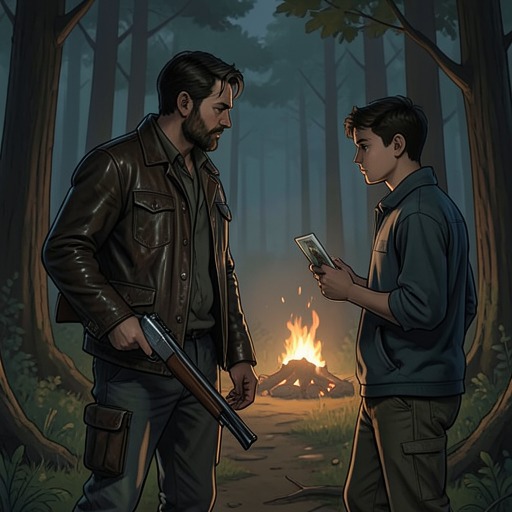
Lee Bodecker calls Arvin’s name and identifies himself as sheriff, claiming that he has come only to ask questions and will not hurt him. He carries a shotgun. When a grouse startles him, he fires, then continues toward the brush. At the edge of the clearing he sees Arvin’s bag, the framed Jesus hanging on the cross, and bones in the trees. He recalls the night Arvin brought him to this place and refers to what Willard did there as terrible. Arvin, concealed behind a tree, uses a piece of dead wood as a distraction; Bodecker fires again toward the sound and advances toward the log. The passage ends with the two men closing on one another, before the confrontation’s outcome is shown.
Significance
The return places two forms of reckoning in the same clearing. Arvin’s inward one is an act of mourning: he recovers a more compassionate understanding of Willard and lays Jack’s remains to rest. Bodecker’s arrival turns that private work into a pursuit, bringing the lawman linked to Willard’s death into the landscape where Arvin has just revised his memory of his father. The ruined house, the surviving crosses, and the abandoned bag make the past materially present, but they do not settle Arvin’s questions or tell him what to do. His prayer ends not with certainty but with an armed encounter beginning at the edge of the place where he once sought guidance.